Indonesia is estimated at over 80% Muslim population, yet 93% of Balinese are Hindu.Islam is 5% and Christianity and Buddhism only 2%.This form of Hinduism called "Agama Tirtal" which translates literally means science of holy water.
The Balinese attach great importance to their religion. The Balinese live religion as rituals, ceremonies ... Each of their actions determine the form they have in their future life. Follows their incredible kindness.
 |
Ceremony in Padang Bai |
This religion is based on the worship of natural elements in ancient animist traditions.Balinese Hinduism is closer to Hinduism in India, but with some differences, including the fact that the Balinese eat beef, unlike the Indians.
Balinese life is completely marked by religion.
The cosmic order is omnipresent in every aspect of life, for example, plans of villages, homes, clothing, the balance of the body are governed by the cosmic order.The mountain symbolizes the center of the world. That is why Mount Agung, Bali Summit, is a sacred mountain. The sky is also a positive element.Between the sky and the basement, the cultivated land is the human world which by their rites balance the world and its forces.The sea and the subsoil are the demons and witches.But life is a perpetual cycle. The sea evaporates and becomes rain and will water the land.The concept of cycles is represented by the swastika (not to be confused with the nazi cross) that cross, for the Hindus, is a sign of balance in life, renewal.

Art mixes with delight and enthusiasm in the religious life of many Balinese gamelan play, dance, paint or sculpt. The island is full of art, for example, every door is decorated.
 |
the door of our room in a normal guesthouse, 17 Eur per night |
 |
Inside of a balinese house |
 |
| decoration of a beam in a house |
The Kecak (pronounced ketchak), consisting of 150 dancers, embodies the army of monkeys in the Ramayana.
 |
Kecak show in Ubud |
Rituals accompany all stages of life. The existence is for them a succession of lives, deaths, rebirths finally ending the "Moksa" when the individual is fully realized. The rites are opening the way to the afterlife and make life on earth.
Rituals:
- Pregnancy (pregnant women wearing amulets to repel the demon Leyak, supposed to eat the entrails of the baby)
- Birth (the baby receives its name at the 14th day of life and should not touch the ground before his 105th day in order not to become impure. It is constantly focused early in his life. The child is breastfed long, sometimes more than 3 years). Adults do not hide anything from adult life to their children. They live without sex taboo, without surprise or guilt.
- Adolescence (adolescent gets bum teeth in public to ward off the vices of life).
- Marriage (purification of the sexual act)
- Death and cremation (ceremonies very important). Unlike Hinduism in India, the Balinese use water and fire to purify the soul of the deceased. The ashes are thrown into the water and the sea-or river-.
- Tourists may be invited to a cremation ceremony.
- Every day the Balinese celebrate something, such as education, machinery, rice, etc. ...
- The Balinese place offerings every morning on their doorstep or on motorcycles, scooters, cars. This is a small palm-leaf basket filled with offerings such as rice, cigarettes, flower petals, a biscuit. Rice, biscuits and cigarettes are offerings to the demons that are not to be bothered by them!

 |
The offerings are eaten by pets... But no matter, the Gods have already taken them. |
- The offerings are presented 3 times per day to the gods. They are used to curry their favor and are a sign of respect.
- The offerings that are most important ceremonies are often decorated with citrus fruit or meat or dead birds.
- Palm leaves are missing in Bali as the offerings are a prominent place in local life.
- At school, girls learn to weave the palm leaves to make baskets of offerings.
- Rituals, ceremonies often create traffic jams in Bali.
Temples:Balinese temples link to the gods, so every house, every business, every restaurant or hotel has its own temple.
There are 11,000 temples in Bali. If you count the family temple, the figure rises to 200,000!They consist of thatched roofs, placed vertically on the square base and carved. There are always an odd number of roofs: 1 to 11, depending on the size of the deity of the temple. The roof is called "Meru".
- All the temples are positioned to face the Besakih temple, the "mother temple" the most sacred of the island, situated at 1000m altitude on the slopes of Mount Agung.
- Each house has a family temple built in the family garden. From the street, we often see the thatched roof. (Note that the Balinese houses are often surrounded by a wall).
- The village temple serves to align the village population
- The temple is built in the professional place within the company or hotel to protect employees
- The national temples, (9 temples in Bali national, provided that the 9 points of Harmony. These temples are known by their 11 thatched vertical roofs).
 |
temple of Mengwi (11 Meru= 11 roofs) |

 |
Bratan temple (Danau Bratan) |
In Bali, each family lives in the same house. Each deals with the whole family. Trades are typically distributed in a balanced way in the family.
BALINESE COMPOUND
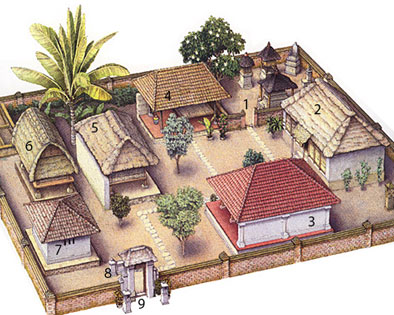
Although many modern Balinese houses, particularly in Denpasar or the larger towns, are arranged much like houses in the west, there are still a great number of traditional Balinese home. In Ubud, for example nearly house will follow the same traditional walled design. Like houses in ancient Rome the Balinese house looks inward; the outside is simply high wall. Inside there will be a garden and a separate small building or bale for each function. There will be one building for cooking, one building for washing and the toilet, and separate building for each” bedroom”. What there won’t be is a living room” because in Bali’s mild tropical climate you live outside – the living room” and “dining room” will be open verandah areas, looking out into the garden. The whole complex is oriented on the kaja-kelod axis, between the mountain and the sea.
In term of the human body, there’s a head- the family temple with its ancestral shrine; arms – the kitchen and rice storage building; and even an anus – the garbage pit. There may be an area outside the house compound where fruit trees are grown or a pig may be kept. Usually the house is entered through a gate-way backed by a small wall known as the aling-aling. It serves a practical and a spiritual purpose, both preventing passer-by from seeing in and stopping evil spirits from entering. Evil spirit can not easily turn corners so the aling-aling stops them from simply scooting straight in through the gate.
- Sanggah kemulan : Family temple
- Umah Meten Sleeping pavilion for the head family
- Tugu : Shrine for house guardian
- Pengijeng : Shrine
- Bale Tiang Sange : Guest pavilion
- Natah : Courtyard with some flower or garden
- Balisekepat: Sleeping pavilion for other relative
- Balisekenem : working and sleeping pavilion
- Paon: Kitchen
- Lumbung : Rice barn
- Aling-aling : screen wall
- Lawang: gate
- Apit lawang : gate shrine


No comments:
Post a Comment